
THE NEUROSCIENCE OF PURITY
Introduction
Polarization is often described as a clash of worldviews, as if two incommensurable visions of the good had simply collided. On one side stand those who insist upon bodily autonomy, structural analysis, and the harms of longstanding hierarchies; on the other stand those who appeal to tradition, transcendent authority, and the fragile architecture of social order. Each camp tends to narrate the other as willfully perverse. When disagreement is not attributed to ignorance, it is attributed to malice: the other side must want to destroy children, communities, or the planet. Within this framing, the task of politics reduces to defeat. There is little reason to imagine repair when one is convinced that the opposing value system is not merely mistaken but diseased.
A different story becomes possible if, instead of beginning with explicit beliefs, we start from the underlying intuitions that scaffold those beliefs. Moral Foundations Theory argues that political differences are partially organized around distinct clusters of moral intuition—care/harm, fairness/cheating, loyalty/betrayal, authority/subversion, and purity/sanctity, among others (Haidt, 2012; see also Moral Foundations Theory, n.d.). In popular summaries, liberals are described as emphasizing care and fairness, and conservatives as giving greater weight to loyalty, authority, and purity (Haidt, 2012). This typology is frequently misread as if different people possessed entirely different moral organs. In practice, all humans deploy these foundations to some extent. What changes is which foundations are chronically activated, and which social objects get mapped onto them.
This article focuses on one particularly volatile foundation: purity. The language of purity—of contamination, defilement, and sanctity—features prominently in the rhetorical strategies of both left and right, even when only one side is explicitly named as moralizing “purity.” Sexual ethics, reproductive rights, trans healthcare, drug policy, and immigration debates are saturated with imagery of polluted bodies and endangered children; so too are environmental activism, anti-racist movements, and food politics, which deploy notions of toxic air, poisoned water, “dirty energy,” and “clean eating.” In each case, something more than disagreement over policy details is at stake. There is a felt sense that certain practices or presences taint a body, a space, or a nation.
It is tempting to treat these purity claims purely as discursive constructions. Critical race and gender scholarship has shown how whiteness, heteronormativity, and able-bodiedness become unmarked standards for “normal” and “clean,” while racialized, queer, and disabled bodies are cast as risky or contaminating (Ahmed, 2004; Frankenberg, 1993). In this register, purity regimes are primarily historical and political: they are technologies for organizing labor, space, and vulnerability. I take that critique as foundational. Yet it is also true that these discursive regimes are not floating in a vacuum. They are metabolized in human nervous systems that come equipped with ancient circuits for detecting contamination, circuits that evolved long before modern race categories or nation-states.
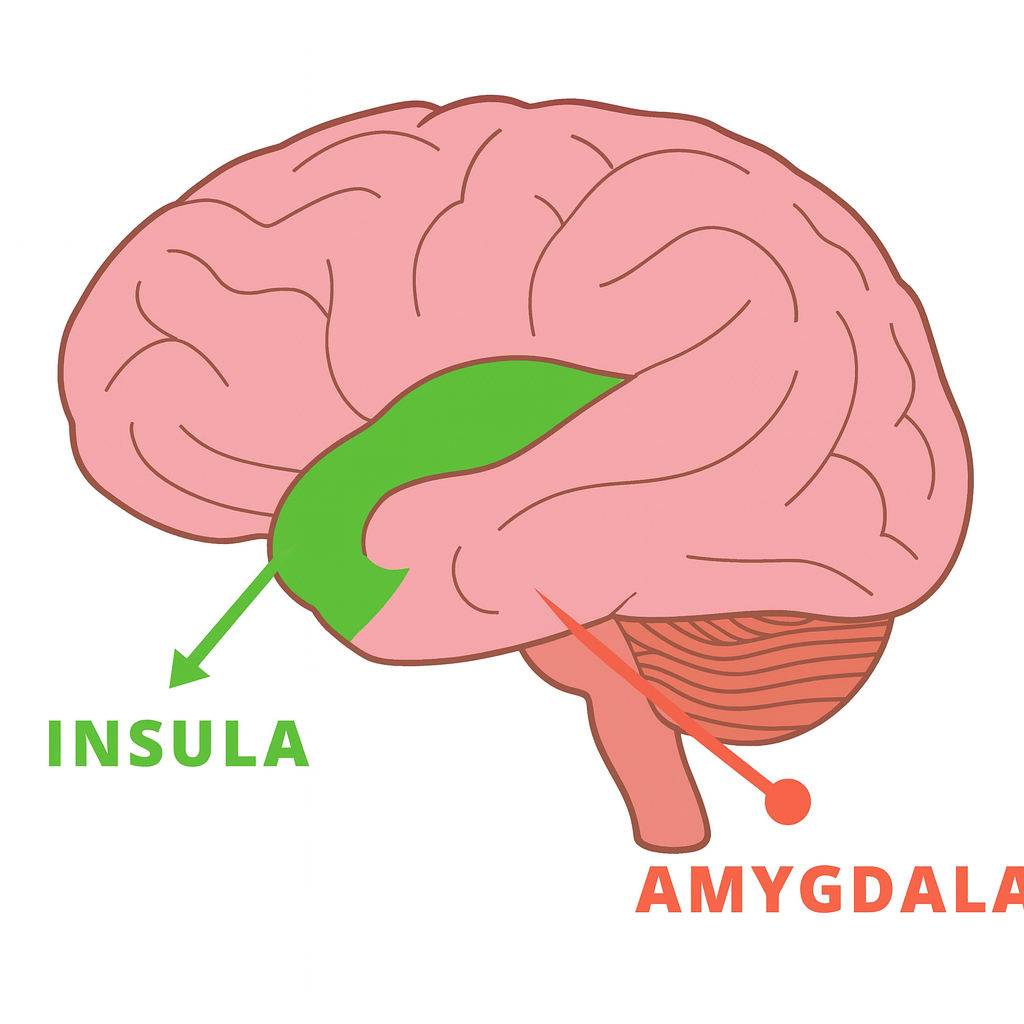
Affective neuroscience has converged on the insula as a key hub in this system. The insula participates in processing taste, bodily sensations, and visceral feelings of disgust; it responds to spoiled food, bodily fluids, and other physical pathogens (Olatunji & Sawchuk, 2005; Rozin, 1999). Functional imaging work shows that the anterior insula is also active when people encounter moral violations that feel “disgusting,” including betrayal, exploitation, and certain sexual taboos (Ivan, 2015; Rozin et al., 1999; Wicker et al., 2003). The same broad network that once helped our ancestors avoid rotten meat and contagious disease can thus be recruited to evaluate symbolic threats and norm violations. What looks, at the level of argument, like a dispute about bathroom policy or dietary choice is, at the level of brain and body, often a dispute about what counts as contamination.
Understanding purity as riding on a shared disgust infrastructure matters for at least two reasons. First, it undermines the convenient fiction that one’s own side is motivated by reason and compassion while the other side is enslaved to primitive gut reactions. Both camps recruit gut reactions; they simply attach them to different objects (Ivan, 2015). Second, it reframes ideological disunity not as a failure of individuals to be sufficiently enlightened, but as a divergence in training histories. Neural circuits do not spring into the world already labeled “gay marriage,” “police violence,” or “genetically modified organisms.” They learn, through families, churches, schools, media, and neighborhoods, which symbols belong in the “pure” bucket and which in the “polluted” bucket (Olatunji et al., 2017; Schaller & Park, 2011). Repair, then, is not primarily about swapping one belief for another, but about retraining mappings between shared circuitry and contested objects.
In what follows, I build on previous work examining whiteness as an invisible vantage point from which “normalcy” is defined to suggest that whiteness also functions as a purity regime (Frankenberg, 1993). Whiteness does not only grant unmarked status; it organizes entire geographies of cleanliness and dirt—who belongs where, which bodies are welcome in which bathrooms or classrooms, which neighborhoods are deemed “safe,” and which are framed as contaminated spaces requiring policing (Ahmed, 2004). These racialized purity scripts become entangled with neurocognitive disgust systems, making some forms of prejudice feel like common sense, and some forms of solidarity feel like moral risk. To the extent that liberals and conservatives inhabit differently racialized and classed worlds, they inherit different ideological training sets for their shared disgust machinery.
The central claim of this article is therefore double. First, ideological disunities are sustained by materially unequal histories—of race, class, gender, and institutional power—that train citizens to map danger and contamination onto different bodies and practices (Ahmed, 2004; Frankenberg, 1993). Second, these histories operate through common neurocognitive channels. Recognizing this commonality does not neutralize structural injustice, nor does it promise a technocratic “neuro-fix” for polarization. What it does offer is a more precise target for repair: instead of seeking pure consensus at the level of articulated beliefs, we can aim to make visible the circuits and training processes that underwrite our respective purity claims, and open them to scrutiny.
The remainder of the article proceeds in five steps. Section I outlines the basic science of purity and disgust, describing how ancient disease-avoidance systems become moralized. Section II situates these systems within the racialized history of whiteness as a purity regime. Section III compares liberal and conservative “purity economies,” arguing that both camps mobilize the same structural logic while attaching it to different referents. Section IV examines how media and algorithmic infrastructures amplify moralized disgust. Section V sketches a preliminary program for ideological repair through what I term shared circuitry pedagogy, aimed at loosening the grip of absolutist purity politics without collapsing genuine moral disagreement.
I. Purity, Disgust, and the Behavioral Immune System
The Purity/Sanctity foundation has always been something of an outlier in moral psychology. Unlike care, fairness, or liberty, purity does not obviously describe how one person treats another. It concerns instead the condition of bodies and spaces: the difference between clean and dirty, sacred and defiled. In religious traditions, purity often refers to the proper handling of bodily fluids, sexual activity, and ritual practices; in secular politics, it names anxieties about disease, addiction, pollution, and moral corruption. What binds these domains together is not their content but their affective tone: purity violations feel less like harm done to a discrete individual and more like a contamination of the social or spiritual field (Haidt, 2012; Rozin, 1999).
Neuroscientific accounts of disgust begin with the body. The classic “core disgust” stimuli are things that threaten physical health: rotting food, excrement, vomit, blood, and certain animal bodies (Rozin, 1999; Rozin et al., 1986). These stimuli engage gustatory and visceral processing regions, including the anterior insula, which is heavily involved in representing the internal state of the body (Wicker et al., 2003). The insula helps generate a subjective sense that something has gone wrong: the stomach turns, the mouth tightens, breathing shifts (Olatunji & Sawchuk, 2005). At the same time, the amygdala and related limbic structures evaluate the situation as potentially dangerous, biasing the organism toward avoidance. From an evolutionary perspective, this system constitutes part of a broader behavioral immune system—a suite of psychological mechanisms designed to minimize contact with pathogens before infection occurs (Schaller & Park, 2011).
Crucially, the behavioral immune system is over-inclusive by design. It is safer, from a survival standpoint, to mistakenly avoid something harmless than to fail to avoid something dangerous. This asymmetry creates fertile ground for social learning. If a community repeatedly pairs a particular body, practice, or symbol with expressions of disgust, that object can come to trigger contamination responses even when it poses no intrinsic biological risk (Olatunji & Sawchuk, 2005; Rozin, 1999). Over time, the disgust system becomes a carrier for socially constructed taboos. Eating with one’s left hand, touching a particular caste, marrying outside one’s race, or using the “wrong” restroom may come to feel viscerally wrong, even if one cannot articulate a coherent argument against it (Schaller, 2011; Schaller & Park, 2011).
This is where purity becomes morally and politically potent. Disgust does more than motivate avoidance; it also dehumanizes. Experimental work suggests that people are more willing to endorse harsh punishments, social exclusion, or even violence against individuals and groups that elicit disgust (Ivan, 2015; Pizarro et al., 2011). Because disgust tracks contamination rather than proportional harm, it tends to generate all-or-nothing judgments: once something is polluted, it is wholly polluted. There is no safe dose of excrement in one’s soup, and by analogy, no acceptable degree of contact with those deemed morally contaminating (Olatunji & Sawchuk, 2005; Rozin, 1999). Purity regimes therefore resist compromise. They transform political differences into questions of moral hygiene, where the goal is not negotiation but removal.
From this vantage point, ideological disunity is not simply the product of disagreement over evidence or policy outcomes. It is also the product of competing maps of pollution, written into nervous systems that were never intended to accommodate pluralistic democracies. The same insular circuitry that predisposes human organisms to avoid rotten food is now asked to respond to drag shows, police traffic stops, plastic straws, vaccine mandates, or border crossings. Each community trains its members to experience different phenomena as “disgusting,” and to interpret that disgust as a reliable moral guide. When such communities meet, they encounter not just alternative beliefs but alternative embodied worlds. The question, then, is how to work with this infrastructure without capitulating to it—a question that will guide the later sections on ideological repair.
III. Dual Purity Economies: Conservative and Liberal Training Sets
Moral Foundations Theory is often summarized with a simple contrast: liberals care mostly about harm and fairness, whereas conservatives draw on a broader palette that includes loyalty, authority, and purity (Graham et al., 2009; Haidt, 2012). Large-N surveys and experimental studies do show that self-identified conservatives tend to score higher on the “binding” foundations—especially purity—than liberals, who prioritize the “individualizing” foundations of harm and fairness (Graham et al., 2009, 2013; Smith et al., 2017). If we stop there, however, we get a caricature: conservatives as uniquely obsessed with sanctity and contamination, liberals as rational calculators of harm. More recent work complicates this picture, suggesting that left and right rely on broadly similar moral intuitions when evaluating concrete violations, even if they describe and rank those intuitions differently (Blumenau et al., 2025; Frimer et al., 2013).
From a disgust/purity standpoint, conservatives are indeed more likely to endorse traditional purity norms around sexuality, bodily boundaries, and religious observance. Disgust sensitivity—especially in sexual and pathogen domains—is positively associated with political conservatism and with endorsement of the Sanctity/Degradation foundation (Inbar et al., 2012; van Leeuwen et al., 2017; Reynolds et al., 2020). Practices such as abstinence pledges, opposition to certain forms of sex education, moral condemnation of drug use, and resistance to gender-nonconforming embodiment are often justified in terms of keeping bodies, families, and communities “pure” or “clean.” In this economy, purity is closely tied to tradition and transcendence: the body is a temple, the nation a sacred inheritance, the family a vessel of continuity. Violations feel not just harmful but desecrating.
Yet liberals maintain their own purity regime, even if they rarely name it as such. Environmental activism is saturated with purity language: “clean energy,” “dirty coal,” “toxic air,” “poisoned water,” “contaminated land.” Anti-racist and environmental justice movements likewise frame certain policies and infrastructures as stains on the national conscience—superfund sites in Black neighborhoods, oil pipelines through Indigenous land, police violence in communities of color (Bullard, 1994; Pellow, 2018). Here, pollution is both literal (lead, particulates, carcinogens) and symbolic (the moral rot of treating some lives as disposable). Liberal purity is thus often structural and ecological: it seeks to cleanse institutions and environments of racism, exploitation, and “toxicity,” broadly construed.
These parallel economies are evident in how each side deploys disgust. Experimental work shows that disgust-eliciting depictions of outgroups can increase dehumanization and support for harsh policies across the spectrum, not only on the right (Buckels & Trapnell, 2013; Dalsklev & Kunst, 2015). Conservative media may emphasize images of bodily threat and disorder—crime scenes, drug use, crowds at the border—casting them as contaminants endangering a previously clean social order. Liberal media may highlight images of polluted rivers, police brutality, or racist vandalism as evidence that the body politic has been defiled. In both cases, disgust responses are recruited to mark some practices and presences as intolerable, beyond the reach of negotiation. The difference lies less in whether disgust is used than in what it is trained to track.
The “training set” metaphor helps clarify this symmetry. Every person’s insula–amygdala network is tuned over time by repeated pairings of stimuli and social judgments: this is safe, that is disgusting; this belongs here, that is out of place. For many conservatives, the training set may include sermons, family narratives, and media that associate impurity with sexual nonconformity, secularization, and porous borders. For many liberals, it may include curricula, activist networks, and media that associate impurity with racial hierarchy, fossil fuel extraction, and corporate predation. Moral Foundations measures pick up some of these differences as higher or lower endorsement of abstract foundations, but the lived reality is closer to different mappings onto a shared template (Graham et al., 2013; Schaller & Park, 2011).
Research on moral reframing makes this shared template visible. Feinberg and Willer (2013) found that conservatives became more supportive of environmental protection when pro-environmental arguments were framed in purity terms (for example, “keeping our natural landscapes clean and unspoiled”) rather than in harm terms (“protecting people from health risks”), which liberals typically find more compelling (Feinberg & Willer, 2013, 2015; Feinberg, 2019). Similar studies show that liberals can be more receptive to traditionally conservative positions—such as higher military spending or stricter immigration enforcement—when those positions are framed in terms of care and fairness rather than loyalty or authority. Moral reframing works precisely because both sides possess all the foundations; they simply differ in which ones are habitually salient, and what real-world objects have been attached to those foundations.
Taken together, these findings suggest that talk of “liberal” versus “conservative” morality obscures as much as it reveals. Rather than two alien moral species, we have two purity economies operating on overlapping neural hardware and partially shared moral grammars. Each economy trains its participants to experience different forms of moral pollution as self-evident and to treat opposing purity concerns as either irrational squeamishness or cynical bad faith. For the project of ideological repair, the payoff is not that we can dissolve deep disagreements by pointing to common circuitry, but that we can name the symmetry: both camps are in the business of sanctifying some things and declaring others untouchable. The work ahead is to bring those training sets into view, so that conflicts over borders, bathrooms, pronouns, pipelines, and police are recognized as clashes between rival purity mappings rather than proof that the other side lacks morality altogether.
II. Whiteness as a Purity Regime
If the behavioral immune system supplies a general template for sorting the world into pure and polluted, whiteness supplies one historically specific way of filling in that template. Whiteness is not simply a skin tone; it is a social position that has been constructed as the unmarked norm against which other identities appear as visible, risky, or out of place (Frankenberg, 1993). In Ruth Frankenberg’s interviews with white women in the United States, participants routinely treated their own cultural habits as “just normal,” while race and culture were attributes that other people had. This invisibility is not value-neutral. It allows whiteness to quietly define what counts as a proper neighborhood, a reputable school, a safe body, or a clean home. In other words, whiteness functions as a purity regime: a background standard of tidiness, civility, and safety against which “dirt” is recognized (Ahmed, 2004; Berthold, 2010; Zimring, 2015).
Anthropologist Mary Douglas famously defined dirt as “matter out of place” (Douglas, 2001). Dirt is not an inherent property of substances; it is a judgment that something has crossed a boundary it should have respected. This insight has been widely used to analyze how social orders mark certain lives as contaminating (Campkin, 2013; Douglas, 2001; Shotwell, 2016; Smith, 2007). In a specifically racial register, Debra Berthold traces how nineteenth- and twentieth-century hygiene discourses in the United States and Europe linked cleanliness to whiteness and dirt to racialized others, yoking together “cleanliness and dirt, civilization and savagery, white and dark” (Berthold, 2010). Public health campaigns, immigration restrictions, and eugenic projects all drew on this symbolic pairing. Disease and filth were projected onto Indigenous, Black, Jewish, and immigrant bodies, while white bodies were cast as naturally hygienic and in need of protection from contamination (Berthold, 2010; Zimring, 2015).
Sara Ahmed’s work on the cultural politics of emotion offers a complementary vocabulary for this process. Ahmed (2004) argues that emotions like fear and disgust do political work by “sticking” to certain figures, making some bodies appear as familiar and others as threatening strangers. Whiteness, in this framework, is not just a descriptor but an affective orientation: white subjects learn to feel at home in spaces coded as white, and to experience racialized others as potential intruders whose presence disturbs bodily comfort and spatial order. When a neighborhood is described as “getting sketchy,” or a school as “going downhill,” such evaluations often track shifts in racial composition as much as any objective measure of crime or resources. The sense that something has been dirtied or “let go” is an affective registration of bodies perceived as out of place.
These purity logics are deeply spatial. Urban sociology and planning scholarship has shown how zoning laws, suburbanization, and redlining produced landscapes in which whiteness correlated with well-funded, low-density, “quiet” spaces, and non-whiteness with crowded, surveilled, and environmentally burdened ones (Bullard, 1994; Campkin, 2013; Pellow, 2018; Zimring, 2015). Within such landscapes, practices of “tidying up” frequently take the form of policing and displacement. Unhoused people are swept from business districts; Black and Brown youth are disciplined for “loitering” in malls or parks; migrant laborers are tolerated in fields and kitchens but not in gated communities. Each intervention can be narrated in purely pragmatic language—safety, property values, quality of life—but they are saturated with purity concerns: who belongs where, which uses of space are clean or dirty, which bodies are “matter out of place” (Douglas, 2001).
The language of safety is especially potent in laundering purity politics. Calls to “keep our children safe,” “protect our borders,” or “defend our neighborhoods” often blend genuine concerns about harm with more diffuse anxieties about contamination. Media portrayals that depict immigrants or racialized minorities as disease carriers, criminals, or “invaders” reliably elicit disgust and fear, which in turn increase public support for exclusionary and punitive policies (Buckels & Trapnell, 2013; Dalsklev & Kunst, 2015; Hodson et al., 2014). Experimental studies show that disgust-eliciting portrayals of outgroups can causally heighten dehumanization and willingness to endorse deportation or harsh treatment. In such cases, safety talk functions as a moral fig leaf for purification: the goal is not only to prevent concrete harms but to remove those who are felt to sully the body politic.
Neuroscience adds another layer to this picture without reducing it to biology. A series of fMRI studies by Elizabeth Phelps and colleagues found that, among white American participants, greater differential amygdala activation to unfamiliar Black versus White faces was associated with stronger scores on indirect measures of racial bias, such as the Implicit Association Test and eyeblink startle potentiation (Phelps et al., 2000; Phelps et al., 2003). Importantly, these correlations did not hold for explicit self-report measures of prejudice, and they diminished when participants viewed faces of familiar, positively regarded Black individuals (Harris & Fiske, 2011; Phelps et al., 2000, 2003). The amygdala here is not a “racism module”; it is a threat- and salience-detection hub that has learned, through cultural exposures, to treat certain racialized faces as more attention-worthy or unsettling.
When these neural findings are placed alongside the historical and affective work above, whiteness as a purity regime can be understood as a training environment for disgust and threat circuitry. White subjects, especially those living in racially segregated contexts, disproportionately encounter nonwhite bodies through mediated images of crime, poverty, and disorder, while encountering whiteness through sanitized representations of normalcy and competence (Ahmed, 2004; Frankenberg, 1993). Over time, the insula–amygdala network is repeatedly co-activated with particular racial cues and particular evaluations: this kind of body is “safe,” that kind is “suspicious”; these neighbors are “nice,” those are “rough.” The resulting neural patterns do not determine explicit beliefs, but they tilt the affective playing field. A zoning meeting about a new shelter, mosque, or bus route is not just a deliberation over land use; it is a confrontation between differently trained maps of pollution and safety.
None of this implies that whiteness is reducible to disgust responses, or that only white people participate in purity regimes. Marginalized communities, too, develop their own boundaries of clean and dirty, safe and unsafe, often as survival strategies in the face of structural neglect and violence (Shotwell, 2016). What distinguishes whiteness is its institutional leverage: its definitions of tidiness and contamination are more likely to be encoded in law, policing, school funding, and public health policy. Whiteness, in other words, occupies the position from which purity rules are written and enforced. Recognizing this does not require pathologizing individual white subjects as uniquely fragile or hateful. It requires situating their embodied intuitions within a larger historical system that has long equated their comfort with the proper ordering of space.
Viewed this way, ideological disunity around race, immigration, policing, and public health is not simply a battle between abstract principles of equality and liberty. It is, at least in part, a struggle over which purity regime will govern shared spaces, and whose bodies will be treated as matter out of place. The next section turns to how these regimes play out across the political spectrum, arguing that both liberal and conservative projects mobilize purity logics—often while accusing the other side of being uniquely obsessed with purity.
IV. Media, Algorithms, and the Amplification of Moralized Disgust
If purity logics train the behavioral immune system to treat certain bodies and practices as contaminants, digital media provides the ideal petri dish in which those logics can multiply. The core business model of most large platforms is simple: maximize user engagement—clicks, shares, comments, time-on-site—and sell the resulting attention. Emotional content, especially high-arousal negative emotion such as anger, fear, and disgust, is particularly effective at driving that engagement. Analyses of large-scale datasets show that news framed in emotional, negative terms spreads further and faster than neutral or purely informative content (Robertson et al., 2023; Stanford HAI, 2024). In practice, this means that the very emotions that energize purity politics are those that platforms are structurally incentivized to amplify.
Recent work on moral outrage makes this dynamic explicit. Brady and colleagues (2021) show that social learning and platform design interact to escalate outrage expression over time: posts containing moral-emotional language (“disgrace,” “disgusting,” “evil”) are more likely to be liked and shared, and these social rewards teach users to produce even more outraged content in the future. A complementary series of experiments confirms that engagement-based ranking systems—like the default algorithmic feed on many social platforms—disproportionately boost divisive, outgroup-hostile content, even when users themselves report preferring less toxic material (Crockett, 2017; Milli et al., 2025). Algorithms are not neutral mirrors of public interest; they are amplifiers of moralized emotion.
Disgust is particularly well suited to this environment. As noted earlier, a single disgusting image—such as mutilated bodies or contaminated toilets—can predict a person’s political orientation with striking accuracy based on neural responses alone (Ahn et al., 2014; Schreiber et al., 2013). Because disgust cues are visually vivid, easy to convey in still images, and politically diagnostic, they are prime candidates for what journalists now call “rage bait” or “rage farming”—content crafted to provoke maximum disgust and anger in order to harvest engagement (Goldenberg & Gross, 2020; Goldenberg et al., 2022; Therapy Group DC, 2025). When a viral post proclaims that some policy, protest, or marginalized group is “disgusting” or “filthy,” it is not merely describing a reaction; it is recruiting the viewer’s behavioral immune system into a pre-framed purity war.
Misinformation researchers have converged on a similar conclusion: emotion is a better predictor of sharing than truth. People are more likely to pass along false headlines when those headlines are high in emotional content and congruent with their identity or group norms (Bago et al., 2022; Martel et al., 2020). Negative emotions dominate this landscape. Anger, for instance, significantly increases both the perceived credibility and spread of COVID-19 misinformation (Han et al., 2020). Reviews of emotion-based misinformation diffusion point out that fear, anger, and disgust repeatedly emerge as central drivers of rumor and fake-news virality across platforms (Liu et al., 2024; Munusamy et al., 2024). The European Parliament’s own media literacy guidance explicitly warns that disinformation campaigns play on emotions—especially anger and fear—to lower critical defenses and accelerate sharing (European Parliament, 2025).
Within this attention economy, moralized disgust becomes a particularly efficient currency. Posts that depict outgroups or opposing positions as contaminating—“these people are vermin,” “this policy is sickening,” “this protest is disgusting”—do triple work. They trigger visceral reactions in the insula–amygdala network, signal in-group loyalty by dramatizing moral boundaries, and perform well in engagement metrics that determine algorithmic visibility. In turn, highly engaged posts are more likely to be recommended beyond the original audience, creating feedback loops in which those with the strongest purity rhetoric dominate the conversational space (Goldenberg & Gross, 2020; Goldenberg et al., 2022; Piccardi et al., 2025).
These dynamics do not operate symmetrically in all contexts, but they do cut across ideological lines. Right-leaning accounts may circulate disgust-laden images of crime, immigration, or sexual nonconformity; left-leaning accounts may circulate graphic footage of police violence, environmental devastation, or racist speech. Empirical work on negativity in online news finds that anger and fear terms are strong predictors of click-through and sharing across outlets and audiences (Robertson et al., 2023). From the perspective of the algorithm, both are simply high-engagement content. From the perspective of users, they are evidence that the other side—and the world more broadly—is disgusting, dangerous, and beyond repair.
The net result is what we might call digital moral distortion. When platforms preferentially surface morally outraged and disgust-inflected posts, observers infer that such reactions represent the true emotional tone of “the other side” and of politics more broadly. Goldenberg and colleagues (2022) show that people systematically overestimate the moral outrage of others when viewing social media content, generalizing from highly engaged posts to entire communities. This distorted perception shapes expectations about what is normal or acceptable, nudging users to match the apparent emotional intensity of their peers. Over time, what began as a modest divergence in purity training sets is refracted through an infrastructure that rewards the most extreme, least negotiable purity claims.
For our purposes, the key point is not simply that social media makes us angry, but that it selectively amplifies the signals of purity politics. The behavioral immune system, tuned by histories of whiteness and other purity regimes, is fed a steady diet of digitally curated contamination cues. These cues are interpreted through ideological training sets that mark different bodies and institutions as moral biohazards. Algorithms, optimized for engagement, then learn to prioritize precisely the content that best activates those cues. Ideological disunity is thus no longer just a matter of different communities living in different neighborhoods or consuming different television channels; it is a matter of shared neural hardware being driven toward maximal divergence by a common, profit-seeking infrastructure.
Recognizing this alignment between purity logics and platform incentives sets the stage for the final section. If ideological repair requires reworking the mappings between shared circuits and contested objects, it cannot ignore the mediating technologies that currently reward the sharpest expressions of disgust. The question becomes: how might we build practices and institutions—including but not limited to digital platforms—that make our common circuitry visible, dampen runaway purity spirals, and create conditions under which disagreement need not escalate into mutual decontamination campaigns?
V. Toward Ideological Repair: Shared Circuitry Pedagogy
If purity politics recruits shared disgust and threat circuitry trained on divergent histories, then ideological repair cannot simply mean “teaching people the facts” or “getting them to be reasonable.” It must work at the level of how intuitions are formed, experienced, and narrated. The goal is not to dissolve moral disagreement into a neutral technocracy, but to loosen the grip of absolutist purity claims that cast opponents as irredeemably contaminating. In this final section, I sketch a tentative program of shared circuitry pedagogy: practices that make moral intuitions discussable, reframe purity concerns as partially negotiable, and redesign our environments so that the most extreme disgust signals are not continually amplified.
A first step is neurocognitive demystification. When people learn that disgust has a history—that the same insula that reacts to rotten food can be trained to react to interracial marriage, climate protest, or drag performance—they gain a language for treating their own reactions as signals to be interpreted, not oracles to be obeyed. Psychoeducation about the behavioral immune system, implicit bias, and moral foundations can be offered without insisting that any particular intuition is illegitimate. The emphasis is instead on fallibility: it makes sense that this feels wrong, given what you were shown and told, but feelings are not infallible guides to what should be illegal or unlivable. Similar education can be offered regarding the amygdala and salience networks, clarifying that heightened responses to certain faces, places, or symbols reflect learned associations, not hardwired truths about danger.
Second, repair requires structured opportunities for cross-ideological translation of purity mappings. Rather than debating policy positions in the abstract, participants can be invited to answer more basic questions: What, exactly, do you feel is being contaminated here? What is being protected? For a conservative opposed to gender-neutral bathrooms, the answer might be “the innocence and bodily privacy of children.” For a liberal advocating police abolition, it might be “the moral integrity of a community brutalized by state violence.” Naming these underlying objects of sanctification reveals that both sides are, in different ways, trying to shield vulnerable bodies and shared spaces from what they take to be moral biohazards. This does not erase disagreement about which hazards are real or which protections are just, but it reorients the conversation from “you are monsters” to “we are sanctifying different things, often in mutually exclusive ways.”
Third, institutions can be designed to de-escalate purity spirals rather than inflame them. Within journalism, this might mean shifting away from coverage that relies on disgust-laden imagery of outgroups and toward formats that foreground context and tradeoffs. Within education, it might mean structuring curricula that juxtapose different purity regimes—religious, secular, racialized—and invite students to trace how each emerged from material histories of disease, labor, and violence. Within social platforms, it could entail throttling the automatic promotion of high-disgust, high-outrage content, or at minimum giving users clearer options to opt out of such material without withdrawing from public life altogether. These interventions do not presuppose agreement about correct norms; they simply refuse to let the most viscerally provocative content define the boundaries of the thinkable.
Fourth, any credible program of repair must attend to asymmetries in power. Because whiteness historically functions as a purity regime with outsized institutional leverage, not all disgust mappings are equally negotiable. When a white homeowner’s sense that a Black neighbor “doesn’t fit” translates into calls to police, zoning restrictions, or school resegregation, the behavioral immune system of one group is being backed by the coercive force of the state. Shared circuitry pedagogy cannot stop at the level of mutual empathy; it must also ask whose purity concerns are routinely encoded in law, whose disgust is treated as a public health emergency, and whose as an overreaction. In some cases, ideological repair will mean withdrawing legitimacy from certain purity claims—particularly those that function as pretexts for racialized exclusion—while still recognizing that the emotions behind them are real and historically produced.
Finally, repair demands a shift in how we narrate our opponents’ minds. As long as ideological conflict is cast as a war between rational, compassionate “us” and irrational, hateful “them,” there is little incentive to explore the training histories that might make some of their intuitions intelligible. Recognizing that conservatives and liberals alike are operating with partially overlapping moral grammars—and that both mobilize purity and disgust in different domains—undercuts the temptation to treat one side as uniquely primitive or uniquely enlightened. It becomes possible to say: we share much of the same neural and moral equipment; we have been taught to fear and sanctify different things; some of those teachings are unjust and must be opposed, but we can oppose them without pretending that the people who carry them are a separate species.
Such an approach will not produce consensus on contested issues like abortion, policing, migration, or gender. Nor should it be expected to. What it can produce, at best, is a thicker description of the conflict: an account of how shared circuits, racialized histories, and mediated environments collaborate to generate clashes that feel existentially contaminating. In that thicker description lies a modest hope—that some portion of our energy can be diverted away from fantasies of mutual expulsion and toward institutional arrangements that acknowledge real disagreement while refusing to treat other citizens as toxic waste to be removed.
End Note: The Mainstream Bias Against “(Broken) Conservative Brains”
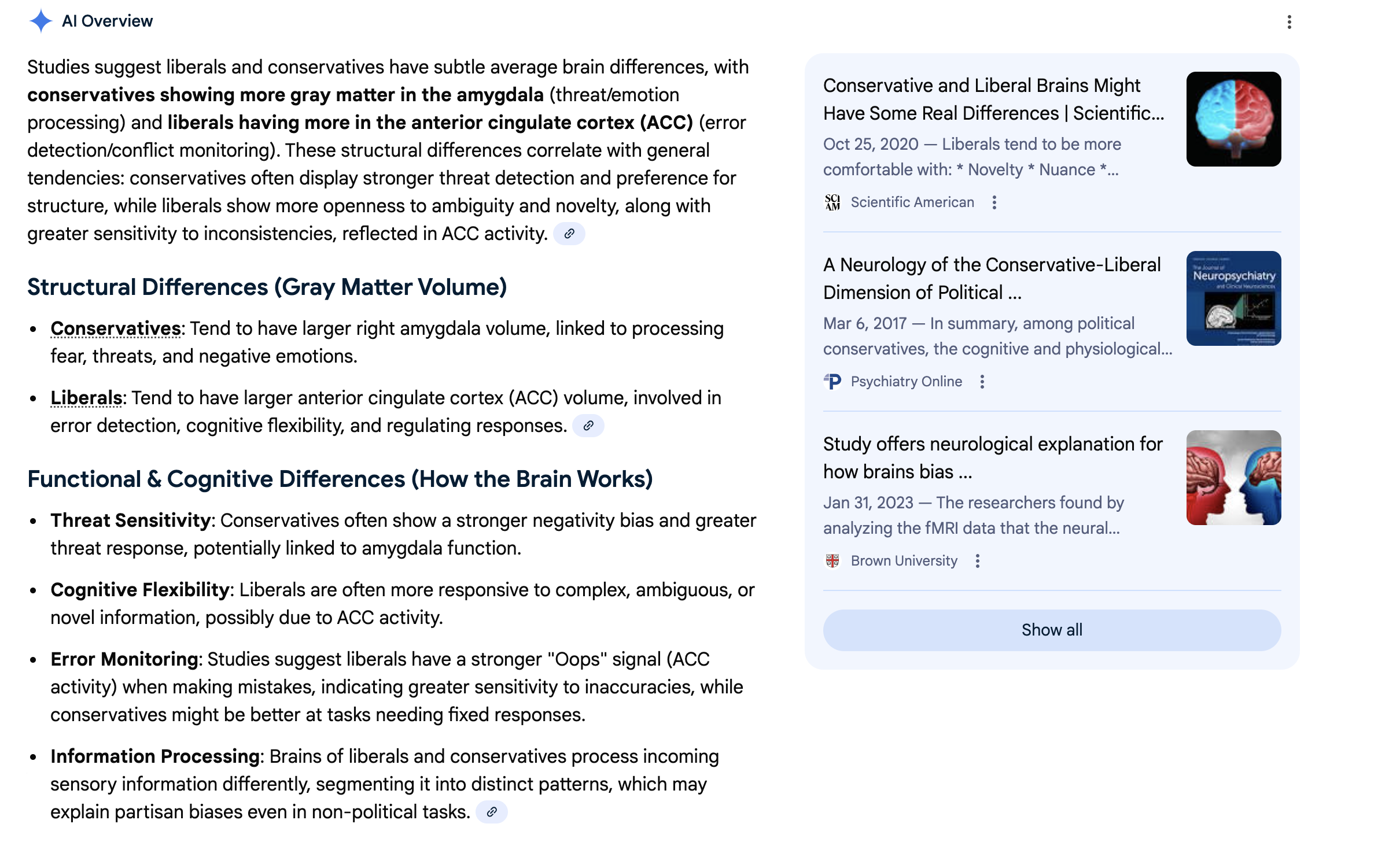
One recurring temptation in neuropolitical work is to convert small, probabilistic findings into sweeping character diagnoses—most notoriously, the idea that conservatives have a “larger fear center,” or that their brains are somehow less evolved. Structural MRI studies do report, on average, slightly greater amygdala volume among people who endorse more conservative positions, and some have found anterior cingulate cortex differences among those who endorse more liberal positions (Jost & Amodio, 2012; Kanai et al., 2011; Schreiber et al., 2013). More recent, higher-powered replications suggest that these effects are tiny, account for an extremely small fraction of ideological variance, and do not justify strong causal claims in either direction. Functional differences in disgust and threat responses follow the same pattern: reliable at the level of groups and tasks, but weak predictors of any given individual’s convictions, let alone their moral worth.
This article has engaged such findings as clues about shared circuitry and training, not as evidence that one camp’s brains are better or worse. To the extent that whiteness and conservatism are associated with particular purity mappings, that association reflects centuries of institutional design, neighborhood sorting, media representation, and theological interpretation—not a biological destiny. Pathologizing conservatives as neurologically deficient simply inverts the problem it claims to solve: it installs a new purity regime in which liberal brains become the benchmark of moral health, and conservative brains the contaminant. If ideological repair is to be more than a polite name for winner-takes-all politics, it must resist this inversion and hold fast to a more difficult claim: that our disagreements are serious, sometimes deadly, and yet still unfolding within a shared, contingent, and revisable human nervous system.
References (APA 7th)
Ahmed, S. (2004). The cultural politics of emotion. Edinburgh University Press.
Bago, B., Rand, D. G., & Pennycook, G. (2022). Fake news, fast and slow: Deliberation reduces belief in false (but not true) news headlines. Journal of Experimental Psychology: General, 151(8), 1608–1617.
Berthold, D. (2010). Tidy whiteness: A genealogy of race, purity, and hygiene. Ethics & the Environment, 15(1), 1–26.
Brady, W. J., McLoughlin, K., Doan, T. N., & Crockett, M. J. (2021). How social learning amplifies moral outrage expression in online social networks. Science Advances, 7(10), eabe5641.
Buckels, E. E., & Trapnell, P. D. (2013). Disgust facilitates outgroup dehumanization. Group Processes & Intergroup Relations, 16(6), 771–780.
Bullard, R. D. (1994). Dumping in Dixie: Race, class, and environmental quality (2nd ed.). Westview Press.
Campkin, B. (2013). Remaking London: Decline and regeneration in urban culture. I.B. Tauris.
Crockett, M. J. (2017). Moral outrage in the digital age. Nature Human Behaviour, 1(11), 769–771.
Dalsklev, M., & Kunst, J. R. (2015). The effect of disgust-eliciting media portrayals on outgroup dehumanization and support of deportation in a Norwegian sample. International Journal of Intercultural Relations, 47, 28–40.
Douglas, M. (2001). Purity and danger: An analysis of concepts of pollution and taboo. Routledge. (Original work published 1966)
European Parliament. (2025). Disinformation and propaganda: Impact on the functioning of the rule of law in the EU. Policy Department for Citizens’ Rights and Constitutional Affairs.
Feinberg, M. (2019). Moral reframing: Shifting political attitudes using moral values. Current Opinion in Psychology, 26, 18–22.
Feinberg, M., & Willer, R. (2013). The moral roots of environmental attitudes. Psychological Science, 24(1), 56–62.
Feinberg, M., & Willer, R. (2015). From gulf to bridge: When do moral arguments facilitate political influence? Personality and Social Psychology Bulletin, 41(12), 1665–1681.
Frankenberg, R. (1993). White women, race matters: The social construction of whiteness. University of Minnesota Press.
Graham, J., Haidt, J., & Nosek, B. A. (2009). Liberals and conservatives rely on different sets of moral foundations. Journal of Personality and Social Psychology, 96(5), 1029–1046.
Graham, J., Haidt, J., Koleva, S., Motyl, M., Iyer, R., Wojcik, S. P., & Ditto, P. H. (2013). Moral foundations theory: The pragmatic validity of moral pluralism. In P. Devine & A. Plant (Eds.), Advances in experimental social psychology (Vol. 47, pp. 55–130). Academic Press.
Haidt, J. (2012). The righteous mind: Why good people are divided by politics and religion. Pantheon.
Han, J., Cha, M., & Lee, W. (2020). Anger contributes to the spread of COVID-19 misinformation. Harvard Kennedy School Misinformation Review, 1(3), 1–14.
Harris, L. T., & Fiske, S. T. (2011). Dehumanized perception: A psychological means to facilitate atrocities, torture, and genocide? Zeitschrift für Psychologie, 219(3), 175–181.
Hodson, G., Kteily, N., & Hoffarth, M. (2014). Of filthy pigs and subhuman mongrels: Dehumanization, disgust, and intergroup prejudice. Testing, Psychometrics, Methodology in Applied Psychology, 21(3), 267–284.
Inbar, Y., Pizarro, D. A., Iyer, R., & Haidt, J. (2012). Disgust sensitivity, political conservatism, and voting. Social Psychological and Personality Science, 3(5), 537–544.
Ivan, C. E. (2015). On disgust and moral judgments: A review. Journal of European Psychology Students, 6(1), 25–36.
Jost, J. T., & Amodio, D. M. (2012). Political ideology as motivated social cognition: Behavioral and neuroscientific evidence. Motivation and Emotion, 36(1), 55–64.
Kanai, R., Feilden, T., Firth, C., & Rees, G. (2011). Political orientations are correlated with brain structure in young adults. Current Biology, 21(8), 677–680.
Liu, X., Li, Z., & Yu, W. (2024). Emotions and misinformation: A systematic review of affective factors in fake news diffusion. New Media & Society, 26(2), 389–410.
Martel, C., Pennycook, G., & Rand, D. G. (2020). Reliance on emotion promotes belief in fake news. Cognitive Research: Principles and Implications, 5, 47.
Milli, S., et al. (2025). Engagement-based ranking promotes divisive content. Proceedings of the ACM on Human-Computer Interaction, 9(CSCW).
Moral Foundations Theory. (n.d.). MoralFoundations.org.
Olatunji, B. O., & Sawchuk, C. N. (2005). Disgust: Characteristic features, social manifestations, and clinical implications. Journal of Social and Clinical Psychology, 24(7), 932–962.
Olatunji, B. O., Armstrong, T., & Elwood, L. (2017). Is disgust proneness associated with anxiety and related disorders? A qualitative review and meta-analysis. Perspectives on Psychological Science, 12(4), 613–648.
Pellow, D. N. (2018). What is critical environmental justice? Polity Press.
Phelps, E. A., O’Connor, K. J., Cunningham, W. A., Funayama, E. S., Gatenby, J. C., Gore, J. C., & Banaji, M. R. (2000). Performance on indirect measures of race evaluation predicts amygdala activation. Journal of Cognitive Neuroscience, 12(5), 729–738.
Phelps, E. A., et al. (2003). Neural correlates of race. Nature Neuroscience, 6(7), 763–770.
Piccardi, C., et al. (2025). The engagement imperative: How algorithms amplify moralized content. Journal of Online Platforms and Society, 2(1), 1–23.
Pizarro, D., Inbar, Y., & Helion, C. (2011). On disgust and moral judgment. Emotion Review, 3(3), 267–268.
Robertson, C. T., Mourão, R. R., & Thorson, K. (2023). Anger, fear, and clicks: Emotional language and news engagement. Digital Journalism, 11(6), 929–952.
Rozin, P. (1999). Disgust: The body and soul emotion. In T. Dalgleish & M. Power (Eds.), Handbook of cognition and emotion (pp. 429–445). Wiley.
Rozin, P., Lowery, L., Imada, S., & Haidt, J. (1999). The CAD triad hypothesis: A mapping between three moral emotions (contempt, anger, disgust) and three moral codes (community, autonomy, divinity). Journal of Personality and Social Psychology, 76(4), 574–586.
Rozin, P., Millman, L., & Nemeroff, C. (1986). Operation of the laws of sympathetic magic in disgust and other domains. Journal of Personality and Social Psychology, 50(4), 703–712.
Schaller, M. (2011). The behavioural immune system and the psychology of human sociality. Philosophical Transactions of the Royal Society B, 366(1583), 3418–3426.
Schaller, M., & Park, J. H. (2011). The behavioral immune system (and why it matters). Current Directions in Psychological Science, 20(2), 99–103.
Schreiber, D., Fonzo, G., Simmons, A. N., Dawes, C. T., Flagan, T., Fowler, J. H., & Paulus, M. P. (2013). Red brain, blue brain: Evaluative processes differ in Democrats and Republicans. PLOS ONE, 8(2), e52970.
Shotwell, A. (2016). Against purity: Living ethically in compromised times. University of Minnesota Press.
Smith, V. (2007). Clean: A history of personal hygiene and purity. Oxford University Press.
Tao, D., Leng, Y., Huo, J., Peng, S., Xu, J., & Deng, H. (2022). Effects of core disgust and moral disgust on moral judgment: An event-related potential study. Frontiers in Psychology, 13, 806784.
Wicker, B., Keysers, C., Plailly, J., Royet, J.-P., Gallese, V., & Rizzolatti, G. (2003). Both of us disgusted in my insula: The common neural basis of seeing and feeling disgust. Neuron, 40(3), 655–664.
Zimring, C. A. (2015). Clean and white: A history of environmental racism in the United States. New York University Press.